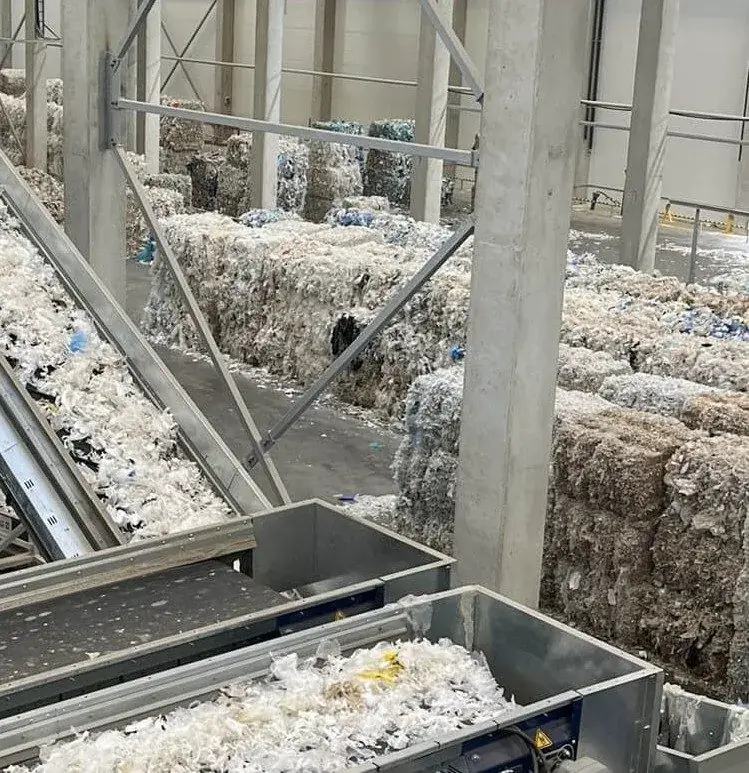
MRF - Material Recovery Facility
Typical tasks: Improve purity and recovery in paper/cardboard,
plastics (PET, PE, PP, films), and metals (aluminum, ferrous), reduce misthrows,
and stabilize NIR-based sorting logic across shifts.
KPI focus: Purity, recovery, throughput, reject rate, misthrow share.
Operational approach: Material flow analysis, assessment of critical NIR sorting
steps,
and testing/standardizing stable operating settings.
LVP - Lightweight Packaging
Typical tasks: Improve yield and sorting quality of PET (clear/colored),
PE (HD/LD), PP, polyolefins, beverage cartons, aluminum, and composites with variable input
quality.
KPI focus: Yield by fraction, purity, recovery, recirculation share,
availability.
Operational approach: Identify loss drivers along the NIR sorting chain,
apply data- and AI-assisted stream analysis, prioritize high-impact actions, and train shift
teams.
MSW - Municipal Solid Waste
Typical tasks: Manage highly heterogeneous input (organics, plastics,
metals, paper), reduce disruptions, and build robust parameter sets for continuous NIR-based
sorting.
KPI focus: Availability, throughput, process stability, unplanned downtime,
disturbance rate.
Operational approach: Bottleneck and disturbance analysis, review of
interactions
between mechanical pre-treatment and NIR sorting, and stabilization of critical phases.
Other NIR-Based Sorting Applications
Typical applications: NIR-based sorting of industrial waste, wood sorting
(waste wood A1-A4, chipboard, MDF), construction and demolition waste,
production residues, and mixed commercial waste with variable material composition.
KPI focus: Separation quality, sorting accuracy, throughput,
misclassification rate, and plant availability.
Operational approach: Evaluate NIR recognition logic for specific material
classes
(for example wood types, plastics, and contaminants), align sensorics, mechanics,
and process parameters, and stabilize sorting performance under varying input quality.